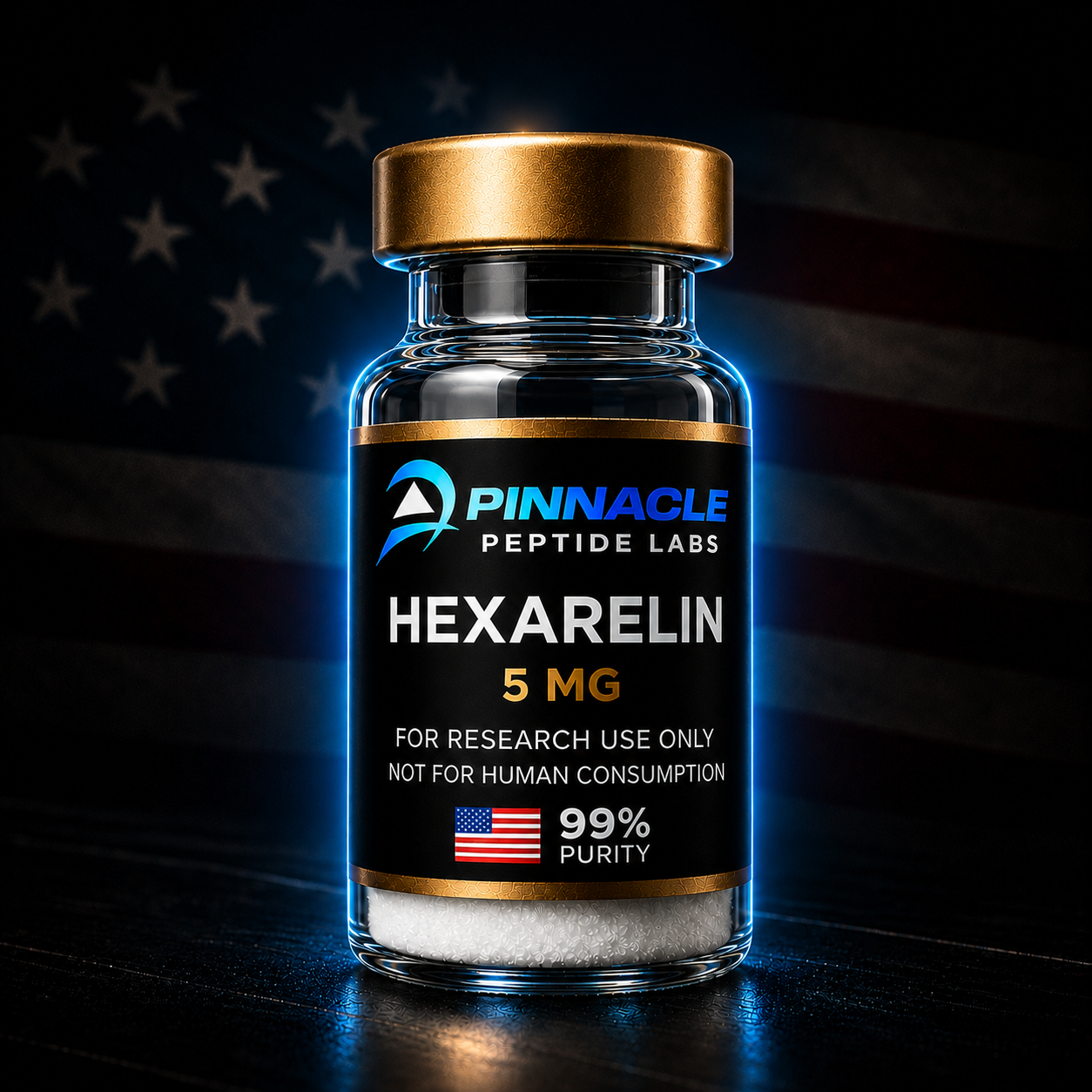
Hexarelin 5mg
Hexarelin 5mg is a synthetic research peptide studied in laboratory and preclinical models involving growth hormone secretagogue receptor signaling, neuroendocrine regulation, growth hormone release pathways, and related cellular signaling mechanisms.
Hexarelin is a six-amino-acid synthetic growth hormone secretagogue (GHS) that has been investigated primarily for its interaction with the growth hormone secretagogue receptor type 1a (GHS-R1a), commonly known as the ghrelin receptor.
Its defined structure and receptor activity have made Hexarelin a useful research compound for investigating the molecular mechanisms associated with ghrelin-receptor activation and growth hormone secretagogue signaling.
Hexarelin 5mg is supplied strictly for laboratory research and analytical investigation. It is not intended for human or animal consumption, clinical use, diagnostic use, therapeutic use, or veterinary use.
Research Specifications
|
|
| Product Name |
Hexarelin |
| Vial Quantity |
5mg |
| Form |
Lyophilized Powder |
| Research Classification |
Synthetic Growth Hormone Secretagogue |
| Primary Research Target |
GHS-R1a / Ghrelin Receptor |
| Peptide Length |
6 Amino Acids |
| Sequence |
His-D-2-Me-Trp-Ala-Trp-D-Phe-Lys-NH₂ |
| Molecular Formula |
C₄₇H₅₈N₁₂O₆ |
| Molecular Weight |
887.0 g/mol |
| CAS Number |
140703-51-1 |
| Intended Use |
Laboratory Research Only |
Growth Hormone Secretagogue Research
Hexarelin belongs to the class of compounds known as growth hormone secretagogues.
Growth hormone secretagogues have been investigated for their ability to interact with receptor systems involved in neuroendocrine signaling and growth hormone regulation. Unlike growth hormone-releasing hormone (GHRH) analogs, Hexarelin primarily acts through the growth hormone secretagogue receptor.
This distinction provides researchers with a tool for investigating growth hormone regulatory mechanisms through a signaling pathway separate from the GHRH receptor system.
GHS-R1a & Ghrelin Receptor Research
A major area of Hexarelin research involves the growth hormone secretagogue receptor type 1a (GHS-R1a).
GHS-R1a is a G-protein-coupled receptor and the principal signaling receptor associated with the endogenous peptide hormone ghrelin. Activation of this receptor initiates intracellular signaling involved in several neuroendocrine processes.
Synthetic secretagogues such as Hexarelin provide researchers with defined molecular tools for studying receptor activation, intracellular signaling, ligand-receptor interactions, and downstream neuroendocrine responses under controlled experimental conditions.
Growth Hormone Signaling Research
Hexarelin has been studied extensively in experimental models examining pathways associated with growth hormone release and regulation.
Growth hormone secretion is controlled by a complex network of stimulatory and inhibitory signals. GHRH represents one major regulatory pathway, while ghrelin and growth hormone secretagogues interact with GHS-R1a through a distinct signaling mechanism.
Laboratory investigation of Hexarelin therefore provides a framework for studying how secretagogue-mediated receptor activity contributes to broader growth hormone regulatory systems.
Neuroendocrine Research
The ghrelin receptor participates in signaling systems extending beyond growth hormone regulation alone.
GHS-R1a has been investigated in multiple areas of neuroendocrine and metabolic biology, making receptor-selective research compounds valuable for studying how this signaling network operates across different experimental systems.
Hexarelin research has consequently included investigation of receptor-mediated signaling, endocrine responses, and interactions between central and peripheral signaling pathways.
These findings remain experimental and should not be interpreted as establishing therapeutic or clinical effects.
Molecular Research Profile
Hexarelin is a synthetic hexapeptide growth hormone secretagogue with the sequence:
His-D-2-Me-Trp-Ala-Trp-D-Phe-Lys-NH₂
The molecule incorporates modified amino-acid residues, including D-2-methyltryptophan and D-phenylalanine, which distinguish its structure from naturally occurring peptide sequences.
The free peptide has a molecular formula of:
C₄₇H₅₈N₁₂O₆
with a molecular weight of approximately:
887.0 g/mol
The CAS Registry Number associated with Hexarelin is 140703-51-1.
As with other research peptides, molecular characteristics can differ when a compound is supplied in a salt form. Analytical specifications should therefore be interpreted alongside applicable batch-specific documentation.
Growth Hormone Secretagogue Structure Research
Synthetic growth hormone secretagogues are useful research tools for investigating how changes in peptide structure influence receptor affinity, receptor activation, signaling selectivity, and biological activity.
Hexarelin’s incorporation of modified amino acids provides researchers with a defined compound for studying structure-activity relationships within the growth hormone secretagogue class.
Comparative research involving Hexarelin and other GHS compounds can also help characterize differences in signaling behavior across compounds that interact with the same receptor family.
Lyophilized Research Peptide
Hexarelin 5mg is supplied in lyophilized powder form for laboratory research.
Lyophilization removes water from the material under controlled conditions, producing a stable dry research format suitable for storage and subsequent laboratory preparation according to established research protocols.
Batch-specific analytical documentation may be available to provide additional information regarding the identity and purity of the research material.
Research Use Only
Hexarelin 5mg is intended strictly for laboratory research purposes only.
This product is not intended for human consumption, animal consumption, clinical use, diagnostic use, therapeutic use, veterinary use, or for the treatment, cure, mitigation, or prevention of any disease.