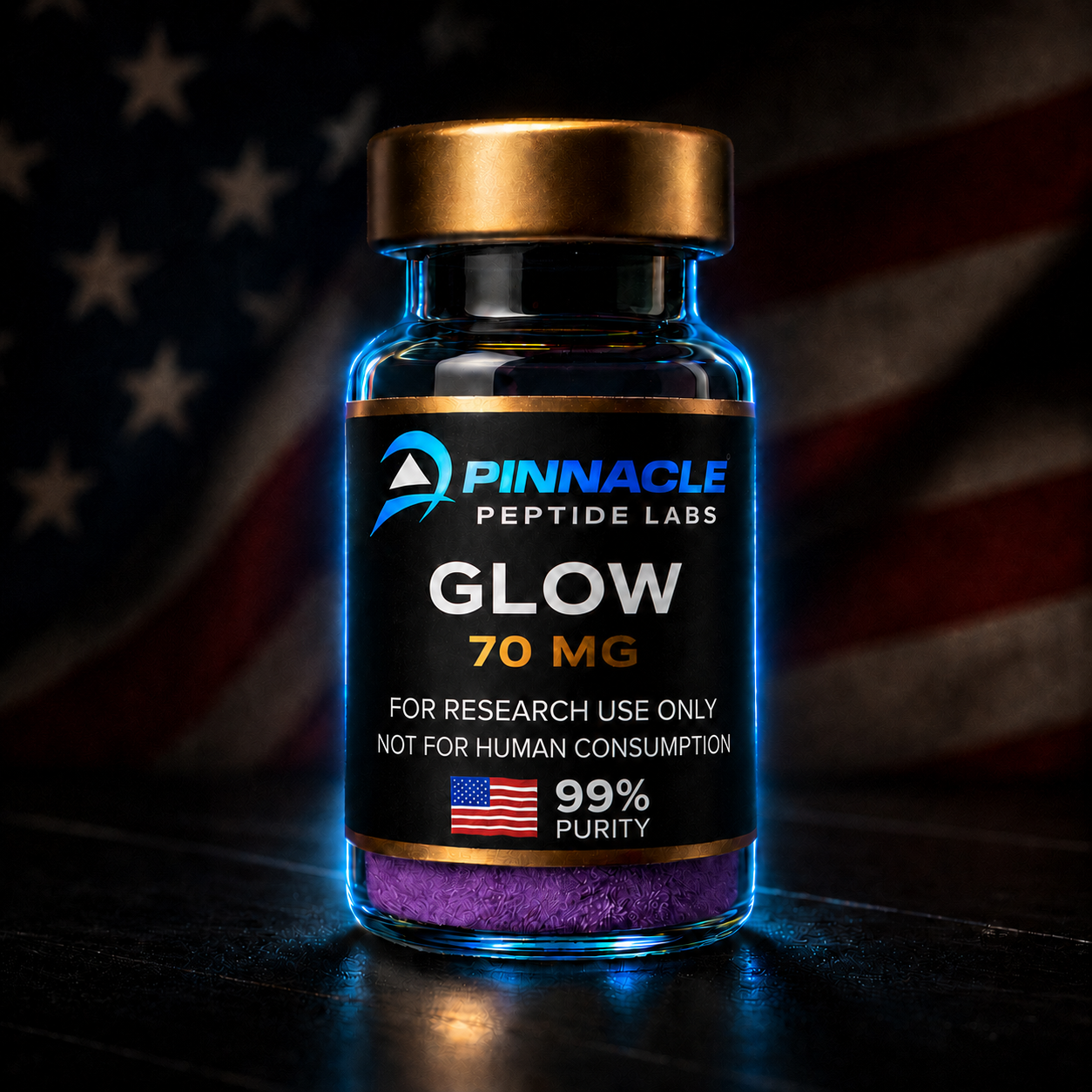
GLOW 70mg
GLOW 70mg is a multi-peptide research blend containing 50mg GHK-Cu, 10mg BPC-157, and 10mg TB-500 in a single lyophilized formulation, for a total research material content of 70mg per vial.
The blend combines three distinct research compounds studied across experimental models involving cellular signaling, extracellular matrix biology, angiogenesis, fibroblast activity, cellular migration, and tissue-response pathways.
Because each component maintains its own molecular identity and research profile, GLOW provides researchers with a combined formulation for investigating multiple peptide-mediated pathways within controlled laboratory settings.
GLOW 70mg is supplied strictly for laboratory research and analytical investigation. It is not intended for human or animal consumption, clinical use, diagnostic use, therapeutic use, cosmetic use, or veterinary use.
Research Specifications
|
|
| Product Name |
GLOW |
| Total Vial Quantity |
70mg |
| GHK-Cu |
50mg |
| BPC-157 |
10mg |
| TB-500 |
10mg |
| Form |
Lyophilized Powder |
| Research Classification |
Multi-Peptide Research Blend |
| Primary Research Areas |
Cellular Signaling, Extracellular Matrix & Tissue-Response Research |
| Intended Use |
Laboratory Research Only |
Multi-Peptide Research Blend
GLOW combines three research compounds with distinct molecular characteristics and areas of experimental investigation.
GHK-Cu is a copper-binding tripeptide complex studied in relation to extracellular matrix biology, collagen-associated pathways, fibroblast activity, gene expression, and copper-dependent cellular processes.
BPC-157 is a 15-amino-acid synthetic peptide studied in laboratory models involving cellular signaling, angiogenesis, fibroblast activity, nitric oxide pathways, and cellular responses to experimental tissue disruption.
TB-500 is commonly associated with a synthetic fragment of thymosin beta-4 and has been investigated in experimental models involving actin-related cellular processes, cellular migration, angiogenesis, and tissue-response signaling.
Combining these compounds provides a research platform for investigating several interconnected cellular pathways within the same experimental formulation.
GHK-Cu Research
GHK-Cu is formed when the tripeptide glycyl-L-histidyl-L-lysine (GHK) coordinates with a copper ion.
Experimental studies have examined GHK-Cu in relation to fibroblast activity, collagen-associated pathways, extracellular-matrix remodeling, gene expression, and copper-dependent cellular processes.
The ability of GHK to coordinate copper makes the resulting complex particularly interesting for research examining relationships between peptide signaling, metal-ion biology, and cellular regulation.
As the largest component of the GLOW formulation, GHK-Cu accounts for 50mg of the total 70mg research blend.
BPC-157 Research
BPC-157 consists of the 15-amino-acid sequence GEPPPGKPADDAGLV.
Experimental research involving BPC-157 has examined pathways associated with endothelial-cell behavior, fibroblast migration, angiogenic signaling, nitric oxide biology, and extracellular-matrix responses.
Rather than being characterized by a single established receptor target, BPC-157 has been investigated across multiple biochemical systems. This makes it useful for experimental research examining complex cellular responses under controlled laboratory conditions.
GLOW contains 10mg of BPC-157 per vial.
TB-500 Research
TB-500 is studied in relation to a short peptide sequence derived from thymosin beta-4, a naturally occurring protein associated with actin regulation and cellular processes.
Research involving thymosin-beta-4-derived sequences has examined cell migration, actin dynamics, angiogenic signaling, and cellular responses to experimental tissue disruption.
It is important to distinguish TB-500 research material from full-length thymosin beta-4. The two should not automatically be assigned the same molecular characteristics or analytical identifiers.
GLOW contains 10mg of TB-500 per vial.
Extracellular Matrix & Cellular Signaling Research
One of the principal research interests surrounding the GLOW blend is the convergence of several pathways associated with cellular signaling and extracellular-matrix biology.
Fibroblasts, endothelial cells, extracellular-matrix proteins, copper-dependent processes, and signaling molecules participate in highly interconnected biological systems. The individual components of GLOW have been investigated in experimental models involving several of these processes.
A combined research formulation allows investigators to examine interactions among multiple peptide-mediated pathways rather than studying each compound exclusively in isolation.
These investigations remain experimental and should not be interpreted as establishing therapeutic or clinical effects.
Molecular Research Profile
GLOW is a multi-component research blend, not a single molecular compound. As a result, the finished formulation does not have one molecular formula, molecular weight, amino-acid sequence, or CAS number.
Each component retains its own molecular identity.
GHK-Cu is a copper-coordinated complex of the tripeptide Gly-His-Lys.
BPC-157 is a 15-amino-acid synthetic peptide with the sequence GEPPPGKPADDAGLV.
TB-500 is associated with a thymosin-beta-4-derived research fragment.
Analytical specifications should therefore be evaluated according to the individual components and applicable batch-specific documentation rather than assigning a single molecular identifier to the complete GLOW formulation.
Lyophilized Research Peptide Blend
GLOW 70mg is supplied in lyophilized powder form for laboratory research.
Lyophilization removes water from the material under controlled conditions, producing a stable dry research format suitable for storage and subsequent laboratory preparation according to established research protocols.
Batch-specific analytical documentation may be available to provide additional information regarding the identity and purity of the research material.
Research Use Only
GLOW 70mg is intended strictly for laboratory research purposes only.
This product is not intended for human consumption, animal consumption, clinical use, diagnostic use, therapeutic use, cosmetic use, veterinary use, or for the treatment, cure, mitigation, or prevention of any disease.